Radiesse in Calgary: The Filler That Lifts Now and Rebuilds Later
Radiesse sits between classic filler and Sculptra: some lift on the day, more support as your own collagen builds. Here is how it works, where it fits, and where it does not.
November 11, 2026

Quick answer: Radiesse is an injectable made from calcium hydroxylapatite (CaHA) microspheres in a soft gel. It does two things: the gel gives visible lift and contour on the day, and the microspheres stimulate your own collagen over the following months as the gel is absorbed. Results typically last 12 to 18 months or longer. It is best for structure in the cheeks, jawline, chin, and temples. It is not used in the lips or under the eyes, and unlike hyaluronic acid filler it cannot be dissolved, which makes injector experience especially important.
Most people researching injectables quickly meet two camps. Hyaluronic acid fillers add volume immediately and can be dissolved. Biostimulators like Sculptra add almost nothing on the day but rebuild your own collagen over months.
Radiesse sits between them, and that is exactly why it is so often misunderstood. It is a filler and a collagen stimulator at the same time. This guide explains what that means in practice, where Radiesse shines, where it is the wrong tool, and how to decide.
What Radiesse Actually Is
Radiesse is made of tiny calcium hydroxylapatite (CaHA) microspheres suspended in a water-based gel. Calcium hydroxylapatite is a mineral that occurs naturally in bone and teeth, and it has a long history of use in medicine.
Each part of the product has a different job:
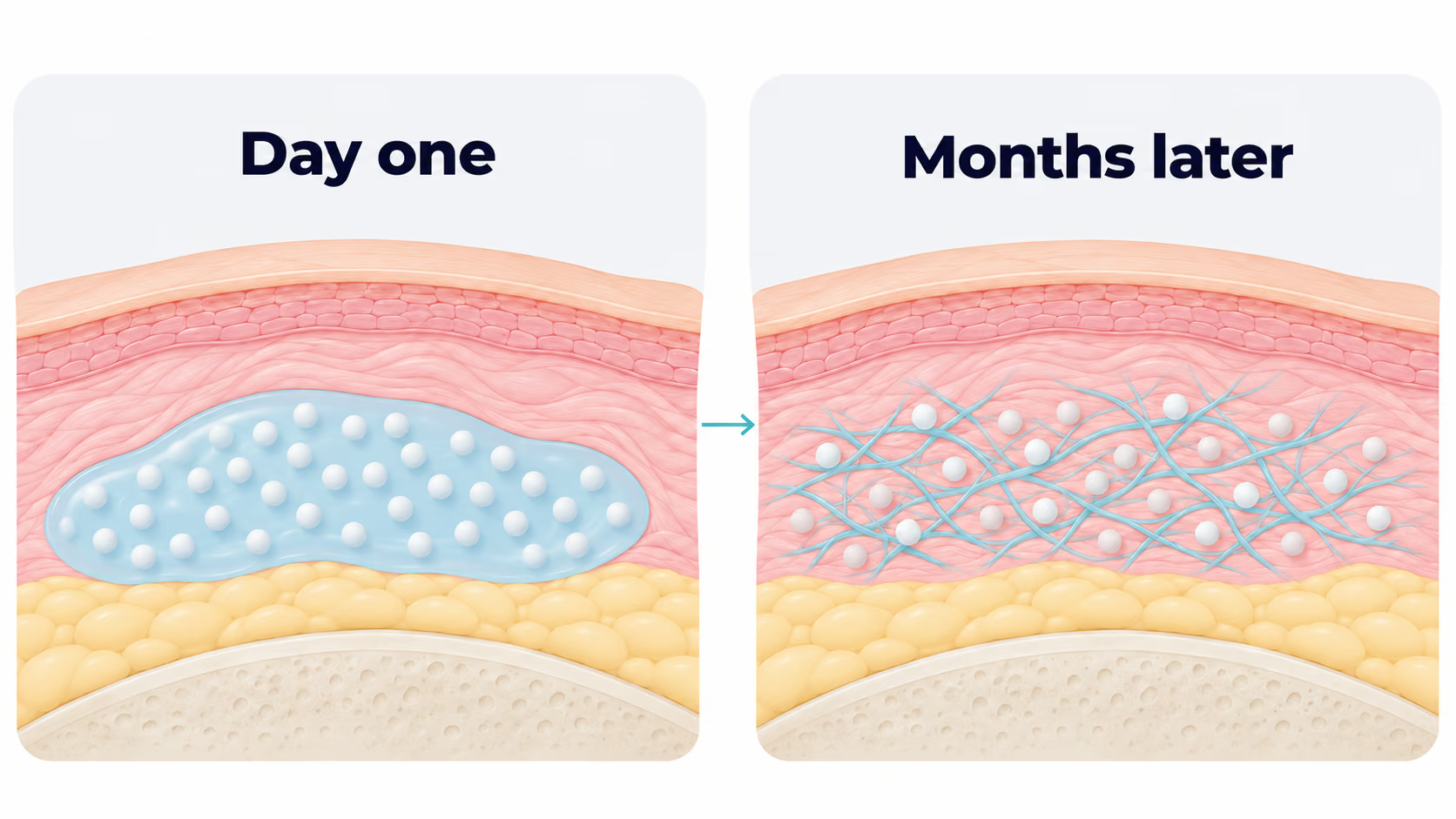
- The gel gives immediate volume and lift once it is placed, which is why you see a change on treatment day. Over a few months, the body gradually absorbs it.
- The microspheres act as a scaffold. Your body responds by building new collagen around them, which takes over the support role as the gel disappears. Eventually the microspheres themselves are broken down and cleared.
That two-stage action is what makes Radiesse different from almost everything else on the menu.
What Radiesse Feels and Looks Like Over Time
- Treatment day: visible lift and contour from the gel, with some swelling.
- First week or two: swelling settles and the immediate result becomes clearer. Mild bruising and tenderness are common.
- Months 1 to 3: collagen production builds as the gel is absorbed, so the result is maintained by your own tissue rather than fading away.
- 12 to 18 months and beyond: results typically last at least this long, and often longer in lower-movement areas, before gradually softening.
Where Radiesse Works Best
Radiesse is firm and structural. That makes it excellent for building support and definition, and a poor choice for soft, mobile areas.
Good areas:
- Cheekbones and midface, to restore projection and support. Our cheek filler guide covers this area in more detail.
- Jawline, for a crisper, more defined edge. See our jawline filler guide.
- Chin, for projection and profile balance. See our chin filler guide.
- Temples, where hollowing makes a face look tired or gaunt.
- Deeper folds, such as marionette lines, where more support is needed than a soft filler gives.
Areas where it is not used:
- Lips. Radiesse is too firm for the lips, and lumps there would be visible and difficult to correct. Lips call for a soft hyaluronic acid lip filler.
- Directly under the eyes. The skin is thin and the area is unforgiving, so tear trough treatment is done with hyaluronic acid.
Radiesse vs Sculptra vs Hyaluronic Acid Filler
All three restore facial volume. They do it in very different ways.
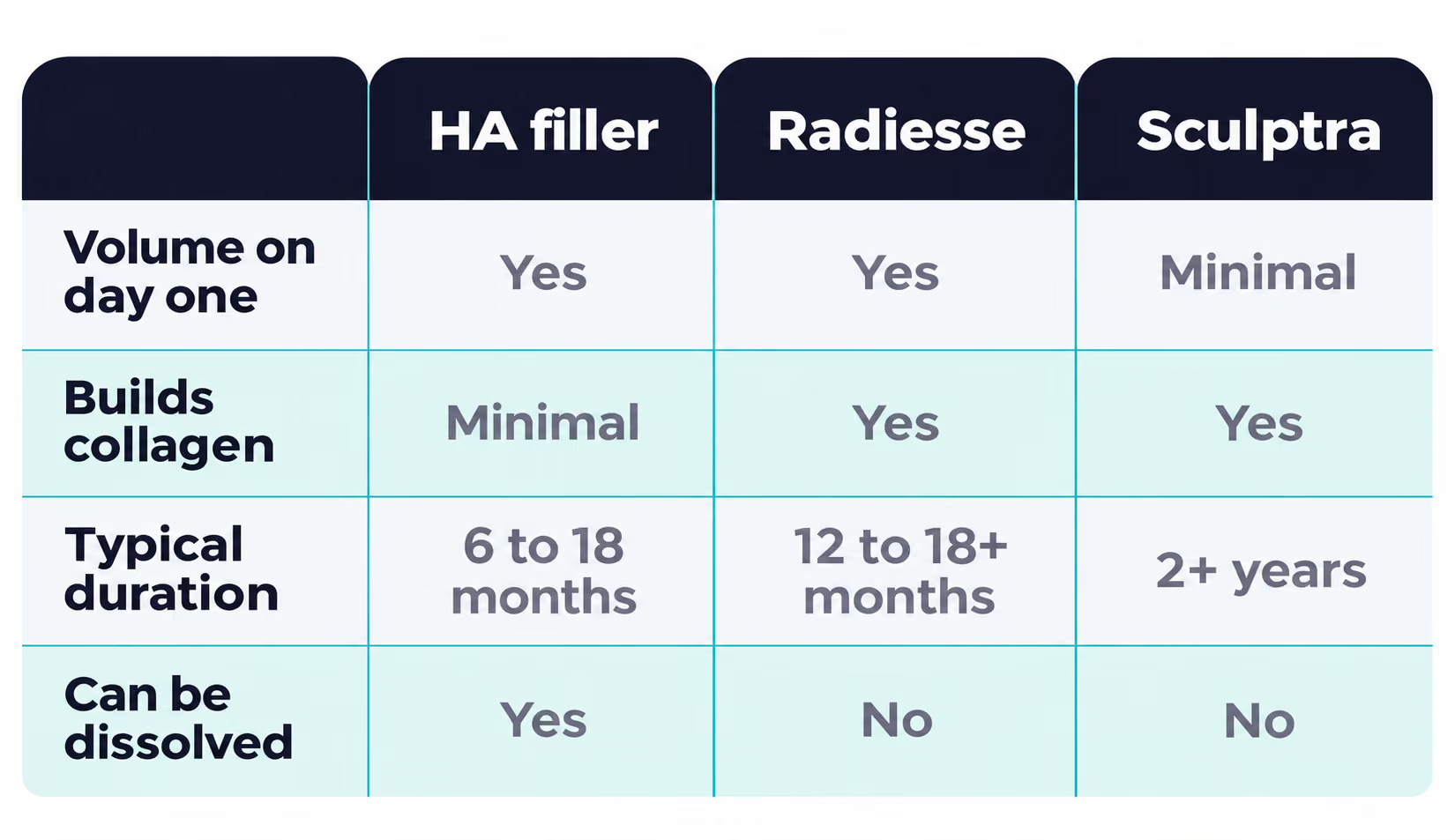
- Hyaluronic acid filler: immediate volume, soft and versatile, lasts roughly 6 to 18 months depending on the area, and can be dissolved with hyaluronidase. The most flexible and forgiving option, and the only one used in the lips and under the eyes.
- Radiesse (CaHA): immediate lift and collagen stimulation, firm and structural, lasts roughly 12 to 18 months or longer, and cannot be dissolved. Best for structure in the cheeks, jaw, chin, and temples.
- Sculptra (PLLA): little visible change on the day, gradual collagen building across a series of sessions, typically lasts two years or more, and cannot be dissolved. Best for broad, gradual volume loss across the face.
A simple way to think about it: hyaluronic acid adds volume, Sculptra helps your body rebuild it, and Radiesse does a bit of both. Our guide to Sculptra vs dermal fillers goes deeper on that comparison.
Radiesse or Sculptra?
This is one of the most common questions we get, and the answer usually comes down to timing and area.
- Choose Radiesse if you want visible structure now, in a defined area like the jawline or cheekbones, with the bonus of collagen support afterward.
- Choose Sculptra if you want a change so gradual nobody notices it happening, across broader areas of the face, and you are comfortable with a series of sessions. Our Sculptra results timeline shows what that looks like month by month.
Some plans use both, along with hyaluronic acid for the lips and other delicate areas. The right combination depends on your face, not on which product is newest.
The Honest Downsides
It cannot be dissolved. This is the most important thing to understand. If hyaluronic acid filler is placed in the wrong spot or a result is not what you wanted, it can be dissolved. Radiesse cannot be reversed in the same way. That does not make it unsafe, but it raises the stakes on technique, product choice, and conservative dosing.
Vascular events are harder to manage. With any filler, a rare but serious risk is product affecting blood supply to the skin. With hyaluronic acid, the filler can be dissolved quickly as part of the response. With Radiesse there is no equivalent. Experienced injectors reduce the risk through anatomy knowledge, injection depth, and technique, and they avoid high-risk areas. Our vascular occlusion case study explains what these events look like and why preparation matters.
Lumps and nodules. Firm areas or small bumps can occur, more often when the product is placed too superficially or in high-movement areas. Correct placement and staying out of the lips and under-eyes keep this risk low.
It is not a first-timer's product. If you have never had filler, starting with reversible hyaluronic acid is usually the wiser first step. You learn how your face responds before committing to something that cannot be undone.
Who Radiesse Suits
- People who want visible structure and contour, especially along the jawline or cheekbones
- People who have had filler before and know how their face responds
- People who like the idea of a result maintained by their own collagen
- People with mild to moderate volume loss in structural areas
It is probably not the right fit if you are treating the lips or under-eyes, want the option to fully reverse the result, are pregnant or breastfeeding, have certain autoimmune or inflammatory conditions, or are prone to keloid scarring. A full medical history is reviewed before treatment.
What Treatment Involves
Your injector assesses your face at rest and in movement, discusses your goals, and explains whether Radiesse, Sculptra, hyaluronic acid filler, or a combination makes the most sense. Most Radiesse products contain lidocaine for comfort. Treatment usually takes 30 to 45 minutes.
Afterward, expect some swelling, tenderness, and possible bruising for several days. Avoid strenuous exercise, saunas, and pressure on the treated area for the first 24 to 48 hours. Our guides to preparing for filler and filler aftercare apply here too.
How Much Does Radiesse Cost in Calgary?
Radiesse is priced per syringe, and the number of syringes depends on the areas treated and how much support is needed. Because it is usually used in structural areas like the jawline and cheeks, plans often involve one to two syringes. Your exact plan and price are confirmed at a complimentary consultation before anything is agreed.
The Bottom Line
Radiesse is a clever product: a filler that also asks your body to rebuild. In the right hands and the right areas it gives structure that lasts. It is also the least forgiving of the three main volume options, because it cannot be undone. The best plan is the one built around your face and your history, not around a brand name.
Book a complimentary consultation and we will talk through whether Radiesse, Sculptra, hyaluronic acid filler, or a combination fits your goals. Results vary from person to person, and suitability, expected outcomes, and risks are reviewed individually.
Frequently Asked Questions
What is Radiesse?
Radiesse is an injectable made from calcium hydroxylapatite microspheres in a gel. The gel gives immediate volume, and the microspheres stimulate your own collagen over the following months.
Is Radiesse a filler?
Yes, and also a collagen stimulator. It adds visible volume on the day like a filler, then supports the area with new collagen as the gel is absorbed. That makes it different from both hyaluronic acid filler and Sculptra.
Radiesse vs Sculptra: which is better?
Neither is better overall. Radiesse gives visible structure immediately in defined areas like the jawline and cheekbones. Sculptra works gradually across broader areas over a series of sessions. Many plans use one or the other depending on the area, and some use both.
How long does Radiesse last?
Results typically last 12 to 18 months, and often longer in lower-movement areas. Because part of the result is your own collagen, it fades gradually rather than all at once.
Can Radiesse be dissolved?
No. Unlike hyaluronic acid filler, there is no reliable way to dissolve Radiesse. That is why it is placed conservatively, in suitable areas, by an experienced injector.
Can Radiesse be used in the lips?
No. It is too firm for the lips. Lips are treated with soft hyaluronic acid filler.
Is Radiesse good for the jawline?
The jawline is one of the areas where Radiesse works best, because its firmness gives a defined edge and good support. Whether it suits you depends on your anatomy, which is assessed at your consultation.
Related Reading
Last Updated:
November 11, 2026

Wondering If Radiesse Is Right for You?
Book a consultation at our Calgary location to get a personalized treatment plan. Every face is different and yours deserves an approach that's tailored specifically to you.