Cheek Filler in Calgary: Cost, Results & What to Expect
How dermal fillers restore mid-face volume and contour, and what to expect at your appointment
June 5, 2026
Quick answer: Cheek filler uses hyaluronic acid to restore lost volume and lift the mid-face, improving contour and softening the folds that form below. Most treatments use one to three syringes and results last 12 to 24 months. Common products include Juvederm Voluma and Restylane Lyft.
The cheeks are the architectural foundation of the mid-face. When they are full and well-positioned, they lift and support everything around them — the under-eye area, the nasolabial folds, and the jawline. As cheek volume fades with age, the whole face can begin to look tired, flat, or sunken, even when nothing else has changed.
Cheek filler offers a non-surgical way to restore that lost volume and rebuild mid-face support using dermal fillers. A skilled injector can recreate natural contour, lift the cheeks subtly, and bring balance back to the face without surgery or downtime.
What Is Cheek Filler?
Cheek filler is a non-surgical injectable treatment that uses hyaluronic acid (HA) to add volume, structure, and lift to the mid-face. HA is a substance that occurs naturally in the body and binds water, integrating smoothly with the surrounding tissue.
For the cheeks, injectors typically choose thicker, more structural HA fillers that can provide lift and hold their shape against the weight of the soft tissue. Products like Juvederm Voluma and Restylane Lyft are commonly used because of their strong lifting capacity and longevity (Few et al., 2015).
Why Cheeks Lose Volume Over Time
Mid-face volume loss is one of the earliest and most impactful signs of facial aging. It is driven by several changes happening at once. The facial skeleton remodels and loses projection, the deep and superficial fat pads of the cheek shrink and descend, and the skin loses elasticity (Mendelson & Wong, 2012).
The result is a flattening of the cheek, a deepening of the nasolabial folds, and often a tired or hollow appearance under the eyes. Restoring volume at the cheek often improves all of these areas at once, because the cheek is the structural support for the entire mid-face.
What Cheek Filler Can Do
Cheek filler can address several concerns together:
- Restore lost volume in the mid-face
- Lift and define the cheekbones for better contour
- Soften nasolabial folds by supporting the cheek from above
- Improve the transition between the cheek and under-eye area
- Rebalance facial proportions for a refreshed, not overdone, look
The best results come from treating the cheek as the structural keystone it is — placing product strategically to lift and support, rather than simply filling a line.
Who Is a Good Candidate?
Cheek filler is appropriate for adults who want to restore mid-face volume or enhance cheek definition without surgery. You may be a good candidate if you:
- Notice flattening or hollowing of the cheeks
- See deepening nasolabial folds or a tired mid-face
- Want subtle lift and contour rather than dramatic change
- Are in good general health with realistic expectations
Cheek filler is not recommended during pregnancy or breastfeeding, with active skin infections in the area, or for those with certain autoimmune conditions or HA allergies. A consultation will confirm whether treatment suits your anatomy and goals.
What to Expect During Treatment
A cheek filler appointment at Arlo Medical typically takes 30 to 45 minutes.
Consultation. Your injector assesses your facial structure, discusses your goals, and develops a treatment plan including product type and the number of syringes.
Preparation. The area is cleaned and a topical numbing cream is applied. Most HA fillers also contain lidocaine for added comfort.
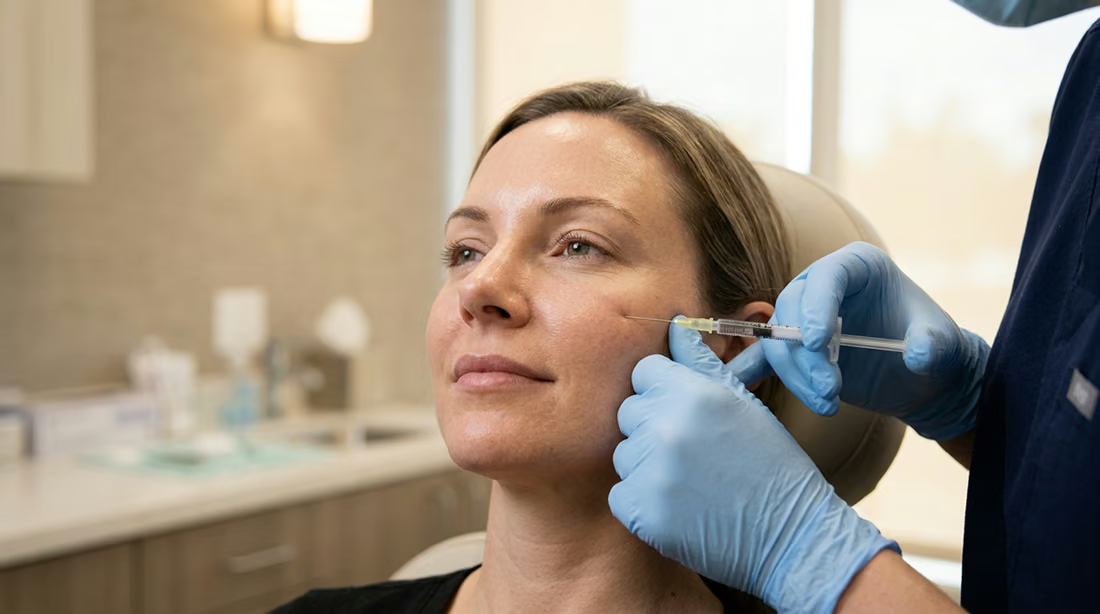
Injection. Filler is placed using a needle or a blunt-tipped cannula, often deep against the cheekbone to provide structural lift. You may feel pressure during the procedure.
Immediate result. You will see added volume right away, though mild swelling can exaggerate it initially. The final result settles over one to two weeks.
Recovery and Aftercare
Recovery from cheek filler is straightforward. Most people return to normal activities the same day. Common short-term effects include mild swelling, tenderness, and occasional bruising, which usually resolve within a few days to a week.
For the first 24 to 48 hours, avoid intense exercise, alcohol, excessive heat, and pressure on the treated area. Sleeping with your head slightly elevated can help reduce swelling.
How Long Does Cheek Filler Last?
Cheek filler generally lasts 12 to 24 months, longer than many other areas because the cheek is a relatively low-movement region and structural fillers are designed for longevity. Individual results vary based on the product, the amount used, and personal metabolism.
Touch-up treatments help maintain results, and many patients find they need less product at follow-up appointments because residual filler provides a foundation. HA fillers can also be dissolved with hyaluronidase if needed, making them fully reversible.

How Much Does Cheek Filler Cost in Calgary?
Cheek filler pricing in Calgary depends on the number of syringes needed, which varies with the degree of volume loss and the lift you are looking for. Many treatments use one to three syringes, with more product needed when significant volume restoration is the goal.
At Arlo Medical, dermal filler pricing is reviewed during your complimentary consultation, where your injector recommends the right amount for your anatomy and goals. Book a free consultation for a personalized estimate.
Cheek Filler vs. Surgical Options
Surgical options for mid-face volume loss include fat transfer and cheek implants. Both can produce long-lasting results, but they involve anesthesia, recovery time, and a permanent or semi-permanent commitment.
Cheek filler offers a non-surgical, reversible alternative that lets you preview the effect of added volume before considering anything permanent. For most patients in their thirties through fifties, cheek filler is a lower-risk, lower-downtime option that can be adjusted or refined as the face changes over time.
Choosing the Right Injector in Calgary
The mid-face contains important vascular structures, including the infraorbital and facial arteries. Cheek filler placed without a thorough understanding of this anatomy carries a small but serious risk of vascular complications. Choosing a practitioner with advanced training in facial anatomy and complication management is essential.
At Arlo Medical, our team of registered healthcare professionals has advanced training in injectable techniques and the management of rare adverse events. We take a conservative, evidence-based approach, because well-placed cheek filler should restore and refresh your features, not change who you are.
Frequently Asked Questions About Cheek Filler
Will cheek filler make my face look puffy?
Not when done conservatively. The goal is to restore natural structure and lift, not to overfill. A skilled injector places product strategically against the cheekbone for support, which lifts the face rather than adding bulk. Overfilled results usually come from too much product placed too superficially.
How many syringes of cheek filler do I need?
Most patients need one to three syringes depending on the degree of volume loss and the lift desired. Significant restoration may require more, sometimes spread across two appointments. Your injector will recommend an amount during consultation.
Does cheek filler help with under-eye hollows?
Often, yes. Because the cheek supports the under-eye area, restoring cheek volume can improve the transition and reduce the appearance of hollowing. In some cases it is combined with tear trough treatment for a complete result.
Is cheek filler reversible?
Yes. Hyaluronic acid cheek filler can be dissolved with hyaluronidase if you are unhappy with the result or want to adjust it. This makes it a low-risk option for first-time patients.
Related Reading
- Dermal Fillers at Arlo Medical
- Jawline Filler: What to Expect and Who It’s For
- Chin Filler in Calgary: Cost, Results & What to Expect
- Nasolabial Fold Filler: Smile Lines Treatment Guide
- Loss of Facial Volume
References:
- Few, J., et al. (2015). Cheek and Midface Augmentation with Hyaluronic Acid Filler. Plastic and Reconstructive Surgery.
- Mendelson, B., & Wong, C-H. (2012). Changes in the Facial Skeleton with Aging: Implications and Clinical Applications in Facial Rejuvenation. Aesthetic Plastic Surgery, 36(4), 753-760.
Last Updated:
June 3, 2026



Ready to Discuss Your Botox Treatment?
Book a consultation at our Calgary location to get a personalized treatment plan. Every face is different and yours deserves an approach that's tailored specifically to you.