Marionette Lines: Why Filling the Line Rarely Works, and What Does
The lines from the corners of the mouth to the chin are one of the most commonly overfilled areas of the face. Here is what causes them and what actually softens them.
November 15, 2026
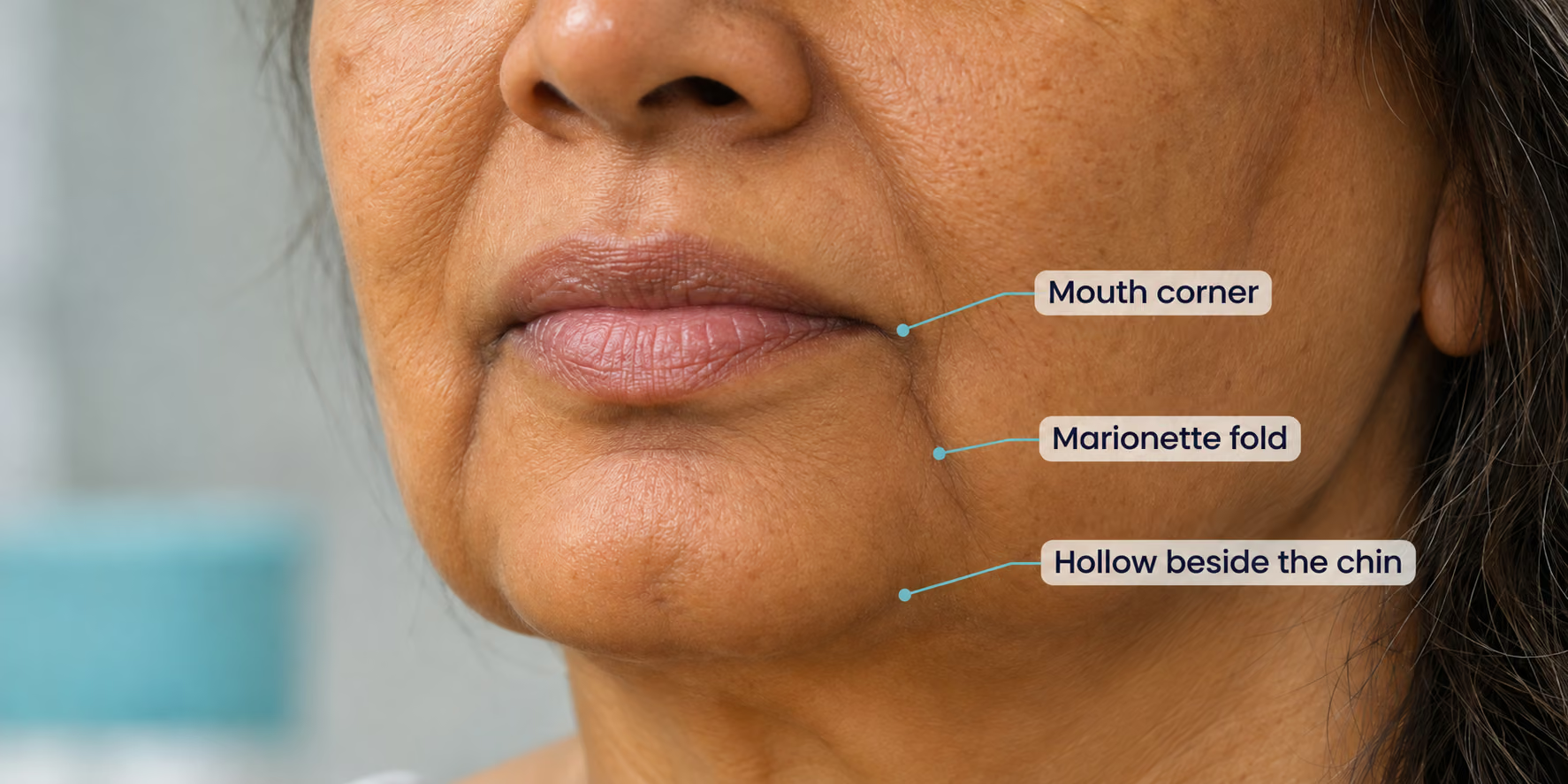
Quick answer: Marionette lines are the lines that run down from the corners of the mouth toward the chin. They are caused mainly by volume loss and sagging in the cheeks and lower face, not by a crease in the skin, which is why filling the line on its own often makes the mouth look heavier rather than younger. The most natural results usually come from restoring support around the line (the cheeks, the area beside the chin, and sometimes the chin itself) with a small amount placed in the line. At Arlo Medical, hyaluronic acid filler is $325 for a half syringe and $650 for a full syringe, and many people need one to two syringes in total.
Marionette lines are the two lines that run down from the corners of the mouth toward the chin. They get their name from the hinged jaw of a ventriloquist's puppet, and they tend to make a face look tired, sad, or cross even when it is completely relaxed.
They are also one of the most commonly overfilled areas of the face. That is not because filler does not work here. It is because the line is usually the symptom, and treating the symptom directly is where most disappointing results come from.
What marionette lines are
A marionette line is a fold, not a wrinkle. A wrinkle is a crease in the skin itself. A fold forms where tissue on one side has dropped or lost volume relative to the tissue next to it, so a shadow appears along the boundary.
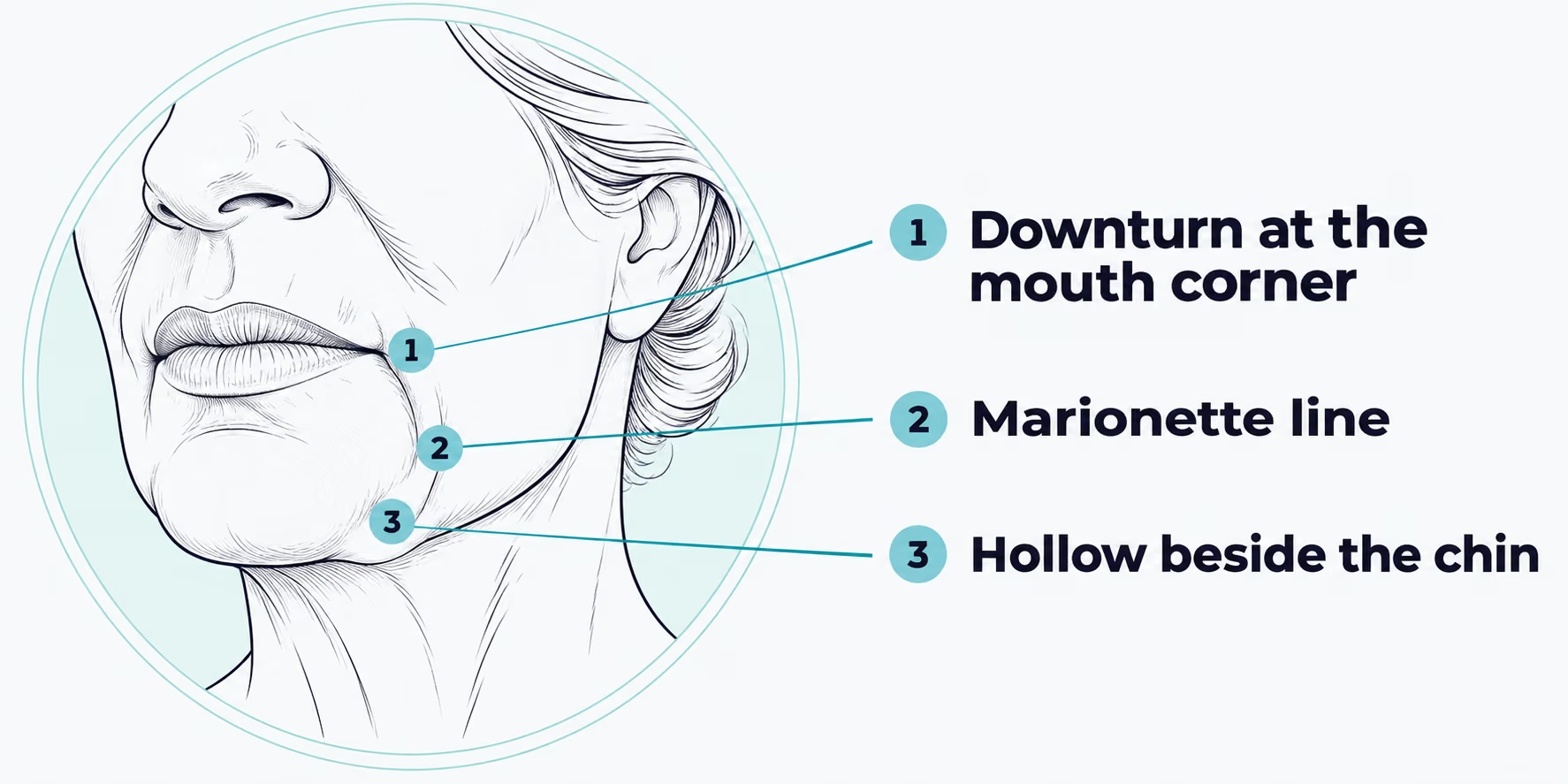
Look closely and most marionette lines have three parts:
- A downturn at the corner of the mouth, so the lips appear to droop at rest
- A groove running down toward the jaw, which is the line most people point to
- A hollow beside the chin, just in front of where a jowl forms, sometimes called the pre-jowl sulcus
Which of those three is most prominent changes what treatment will actually help.
Marionette lines vs smile lines
Smile lines (nasolabial folds) run from the sides of the nose to the corners of the mouth. Marionette lines start at the corners of the mouth and run down. They share a cause, and many people have both, but they behave differently.
Smile lines tolerate filler placed close to the fold reasonably well. The lower face does not. It moves constantly with speech and expression, the tissue is thinner, and small amounts of excess product show quickly as heaviness around the mouth. If smile lines are your main concern, our nasolabial fold filler guide covers that area in detail.
What causes them
Volume loss in the cheeks. The midface loses fat with age, and the tissue it used to support drifts down and forward. Some of that tissue ends up sitting just beside the mouth, deepening the line from above.
Descent toward the jawline. The same process forms jowls. As tissue gathers along the jaw, the hollow beside the chin becomes more obvious and the line beside it deepens. Our guide to what causes jowls explains this in more depth, and the two problems usually travel together.
Bone change. The jaw and chin lose some height and projection over time. Less structure underneath means less support for the soft tissue over it.
Muscle pull. A small muscle at each corner of the mouth pulls downward. As the tissue around it thins, that pull shows more, and the corners of the mouth turn down at rest.
Skin quality. Collagen and elasticity decline, and sun damage and smoking speed that up. This is a real factor, and for most people it is not the main one.
Genetics and face shape matter too. Some people have visible marionette lines in their thirties because of how their face is built, not because of anything they did.
Why filling the line alone often backfires
This is the most useful thing to understand before you book anything.
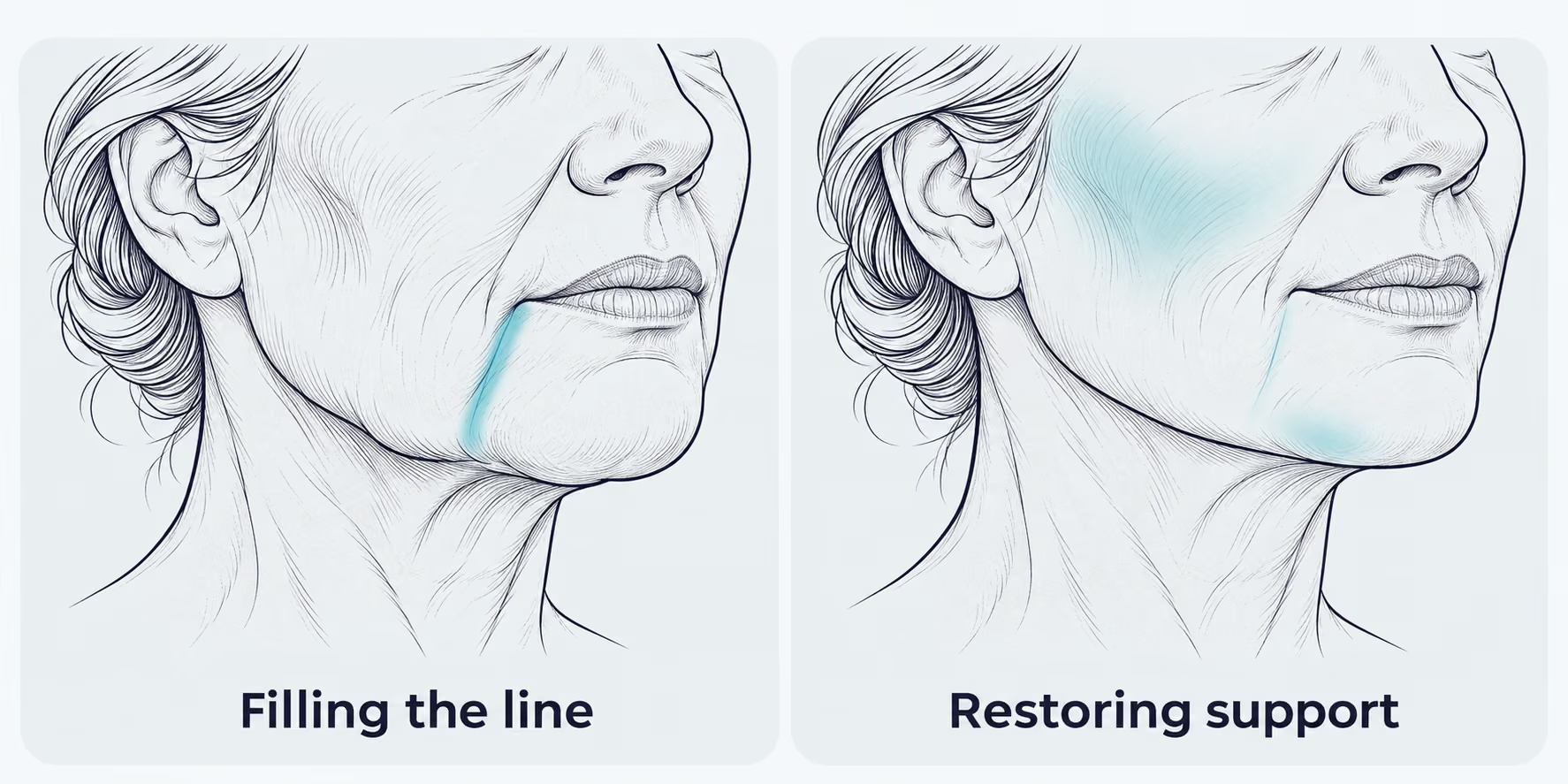
When a marionette line is mainly caused by tissue descending from above, filling the groove adds volume to an area that already has too much weight sitting in it. The line may look shallower for a while, but the lower face can look fuller, heavier, and more static than before. That heaviness around the mouth is what people usually mean when they say someone looks "done".
It also tends to drive more treatment. The result looks slightly off, more product is added to correct it, and the lower face gradually becomes heavier.
That does not mean filler should never go into the line itself. A small, well-placed amount often helps soften what remains. It means the line is usually the last place to treat, not the first.

What actually helps
Restoring support in the cheeks. For many people this is the first and most effective step, even though it happens well above the area that bothers them. Rebuilding support in the cheeks lifts some of the tissue that has drifted toward the mouth, and the line softens indirectly. Our cheek filler guide covers that treatment.
Filling the hollow beside the chin. Restoring the small hollow in front of the jowl makes the jawline read as one smooth line again, which reduces the shadow at the bottom of the marionette line. This is often where the most visible change comes from.
Supporting the chin. Where the chin has lost projection, a small amount of filler there gives the lower face a stronger base. Our chin filler guide explains when that helps.
A small amount in the line itself. Once support has been restored around it, a soft, flexible hyaluronic acid filler can be placed in the remaining groove and under the corner of the mouth to lift the downturn. Because this area moves so much, the product needs to be soft enough to move with it.
All of these use dermal fillers, and the hyaluronic acid products we use can be dissolved with an enzyme called hyaluronidase if needed. That reversibility matters in an area this visible.
Sculptra for gradual, wider volume loss. Where volume loss is spread across the lower face rather than concentrated in one spot, Sculptra rebuilds support by stimulating your own collagen over several months. Results build from about six to eight weeks and typically last two years or more. It is not used directly in the lips or the line at the corner of the mouth, and it cannot be dissolved, so it suits people who already know they are comfortable with treatment.
Plexr Plus for skin quality. Where crepey, lax skin around the mouth and chin is a large part of the problem, Plexr Plus tightens the skin itself. It does not lift descended tissue, and it is best thought of as a finishing treatment once support has been addressed. Plexr treatment for the marionette area is $800.
A thread lift for descent. Where tissue has descended along the jaw and skin quality is reasonable, a thread lift repositions soft tissue mechanically. It is more often used for early jowling than for the marionette line itself, but the two improve together.
Marionette lines filler gone wrong: the usual causes
Searches for this are common, and the causes are fairly consistent.
Too much product in the line. The commonest one, covered above. The result is a heavy, puffy look around the mouth, worse when talking or smiling.
The wrong product. A firm filler designed for structural areas such as the cheekbone or jaw can feel stiff and look lumpy in an area this mobile.
Migration. Filler placed too superficially, or in too large a volume, can spread beyond where it was meant to sit. Our guide to filler migration covers how to recognise it and what actually fixes it.
Hyaluronic acid filler can be dissolved, so most of these problems are correctable. The better approach is avoiding them with a conservative first treatment and a review appointment once the swelling has gone down.
Risks worth knowing about
Like any filler treatment, the main short-term effects are swelling, tenderness, and bruising for a few days. Small lumps can occur and usually settle or can be massaged or dissolved.
The lower face also contains important blood vessels close to where filler is placed. A vascular occlusion, where filler blocks blood flow, is rare, and it is the most serious complication of filler treatment anywhere on the face. It needs immediate recognition and treatment with hyaluronidase. We keep hyaluronidase on site, and we have published a real case study of a suspected vascular occlusion so you can see exactly how it is handled. Ask any clinic you are considering what its protocol is.
How much filler do marionette lines need?
It depends on whether the line alone is being treated or the support around it. As a general guide:
- Mild lines with good cheek support: often a half to one syringe, shared between both sides
- Moderate lines with some volume loss above and beside them: often one to two syringes in total, across the cheeks, the hollow beside the chin, and the line
- More advanced lines with established jowling: usually a staged plan over two appointments, and sometimes a conversation about whether surgery would serve you better
A conservative first appointment with a review afterward is almost always the better route. Adding a little more later is easy. Taking it away means dissolving it.
How much does marionette lines filler cost in Calgary?
At Arlo Medical, hyaluronic acid filler is $325 for a half syringe and $650 for a full syringe. Most marionette line plans fall between one and two syringes in total, so $650 to $1,300, depending on how much support the surrounding areas need. Plexr Plus for the marionette area is $800. Your exact plan and price are confirmed at a complimentary consultation, before any treatment.
How long do results last?
Filler in the lower face generally lasts around 9 to 12 months, and sometimes less in the line itself because the area moves so much. Filler placed in the cheeks often lasts longer. Our guide to how long dermal fillers last breaks this down by area. Sculptra typically lasts two years or more.
What to expect
The appointment usually takes 30 to 45 minutes, including numbing. Filler shows a change immediately, with the final result at about two weeks once swelling settles. Avoid strenuous exercise, alcohol, and pressure on the area for the first day or two, and see our dermal filler aftercare guide for the full list.
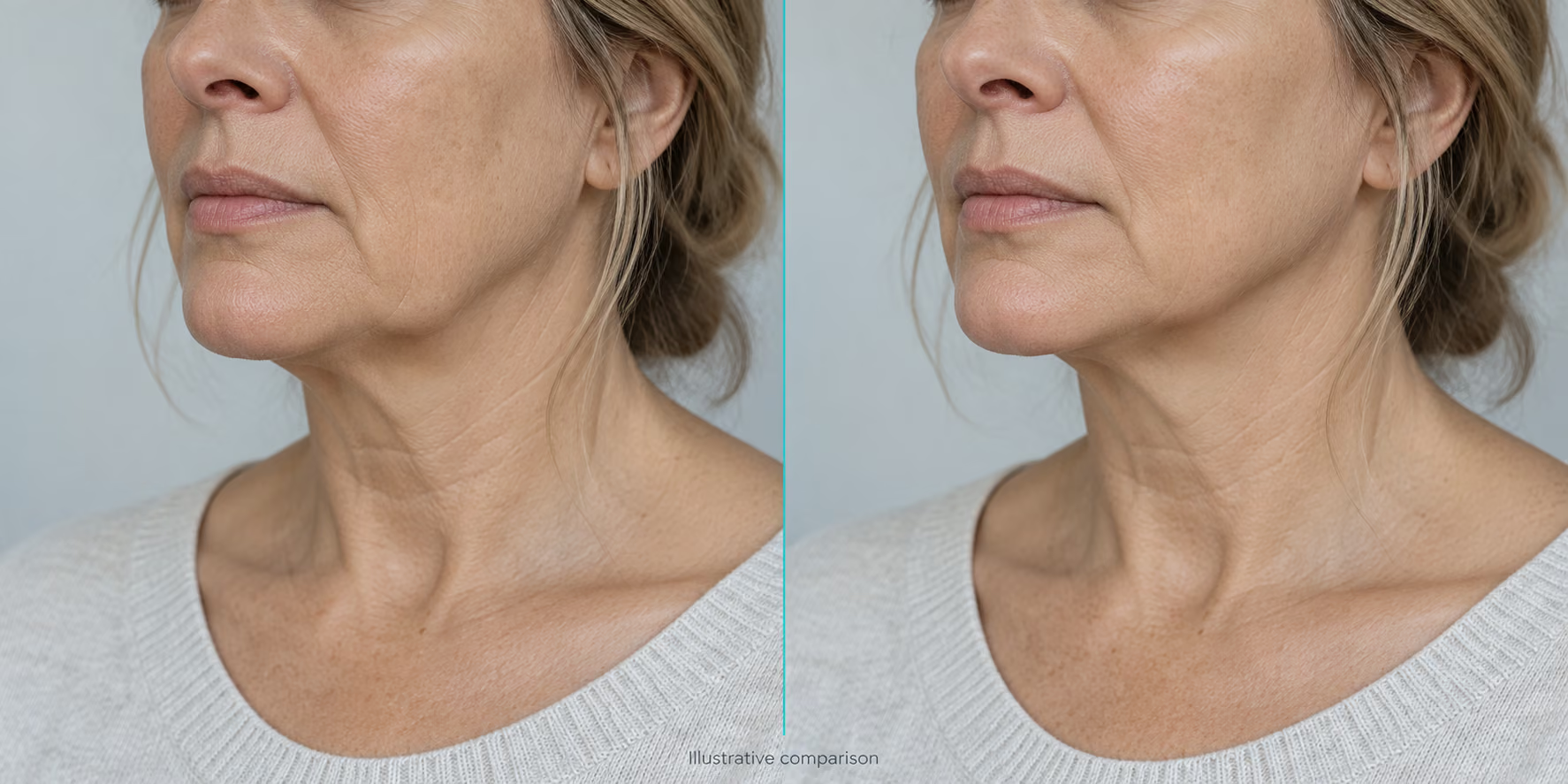
The best way to judge the result is a photograph taken at the same angle and in the same light as your before photo. The change tends to read as a fresher, less tired lower face rather than a missing line, which is usually the result people actually want.
When filler is not the answer
Non-surgical treatment works well for mild to moderate marionette lines. It does not match a lower facelift when there is significant loose skin, heavy jowling, or laxity extending into the neck. If that is what we see, we will tell you and suggest a plastic surgeon. Spending money on filler that cannot reach the real problem is a worse outcome than being told early.
Where to start
A useful consultation for marionette lines looks at your face at rest, while talking, and from the side, and works out whether the line is mainly coming from above, from beside the chin, from the skin itself, or from all three. That answer decides the plan.
Book a complimentary consultation and we will explain what is driving your lines, what is realistic, and what it would cost before anything is done. Results vary from person to person, and suitability is assessed individually.
Frequently Asked Questions
What is the best filler for marionette lines?
There is no single best product. The line itself needs a soft, flexible hyaluronic acid filler that moves with the mouth, while the cheeks and the area beside the chin often need a firmer product that gives structure. Most good results use more than one product in more than one place.
Can you get rid of marionette lines completely?
Usually not, and trying to erase them completely is how the lower face ends up looking overfilled. The realistic goal is softening the line and the downturn at the corners of the mouth so the face looks rested at rest.
Is it better to treat the cheeks or the marionette lines?
For many people, the cheeks first. When the line is caused by tissue drifting down from the midface, restoring support there softens the line indirectly. A small amount in the line itself is then added if needed.
Can Botox help marionette lines?
Using neuromodulators in the lower face for this purpose is not an approach we offer or advertise. If you have read about it elsewhere, bring the question to a consultation and we will talk through what is appropriate for your anatomy.
Do facial exercises or face yoga help?
There is no good evidence that they do. Marionette lines form mainly from volume loss and descent, not weak muscles, and exercise does not restore lost volume or lift descended tissue.
How long does marionette lines filler last?
Generally around 9 to 12 months in the lower face, sometimes less in the line itself because the area moves so much. Filler placed in the cheeks to support the area often lasts longer.
What age do marionette lines start?
Many people first notice them in their forties, but face shape and genetics mean some people see them in their thirties. Earlier, milder lines are generally easier to soften than established ones.
Related Reading
Last Updated:
November 15, 2026
More from the Blog


Ready to Soften Your Marionette Lines?
Book a consultation at our Calgary location to get a personalized treatment plan. Every face is different and yours deserves an approach that's tailored specifically to you.