Filler Migration: How to Tell If It Has Happened, and What Actually Fixes It
Most of what people call migration at two weeks is swelling. Real migration looks different, takes longer to appear, and is not fixed by adding more.
September 10, 2026

Quick answer: Filler migration is when hyaluronic acid filler settles outside the area it was placed, most often as a soft shelf above the lip border. Genuine migration usually appears months after treatment, not days, so anything you notice in the first two weeks is almost certainly swelling. It is generally not corrected by adding more filler. The usual approach is to dissolve the migrated product with an enzyme administered by a clinician, wait for the tissue to settle, then rebuild conservatively. The strongest protection is spacing treatments properly, because repeated stacking is the most common cause.
If you have looked in the mirror and thought your lip border is blurrier than it used to be, you are asking a reasonable question, and the internet will give you a confident answer within about four seconds. Most of those answers are wrong in the same direction: they will tell you this is migration, and that you need it dissolved.
Often it is not, and you do not.
Here is what filler migration actually is, how to tell it apart from the two things people routinely mistake for it, why it happens more often than the industry likes to admit, and what genuinely fixes it.
What Migration Actually Means
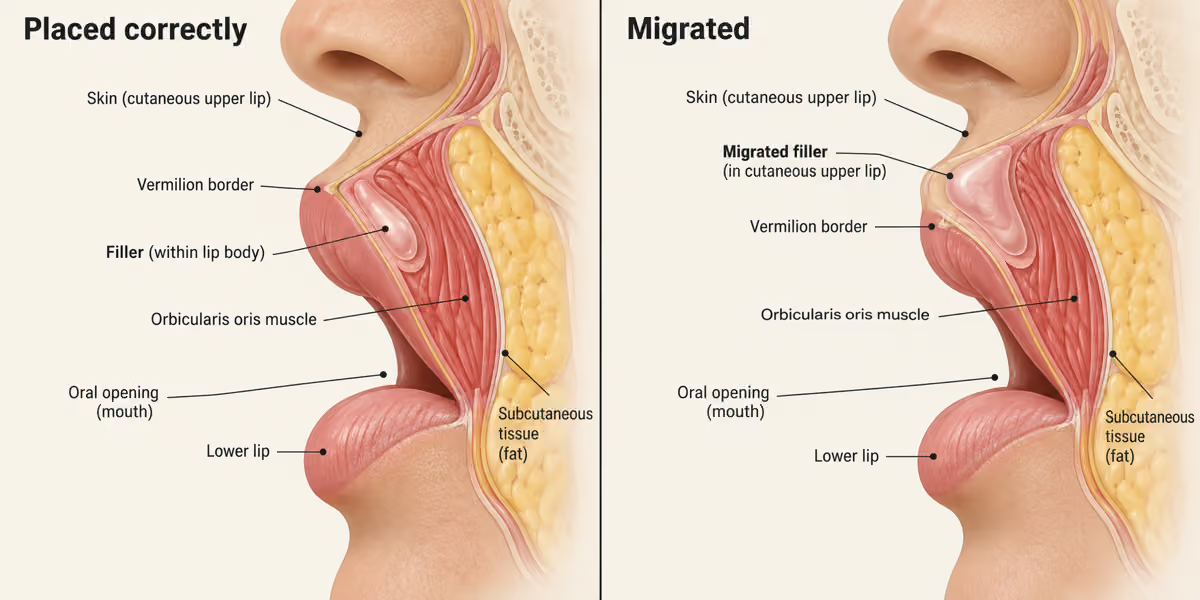
Dermal filler is a gel. It is placed into a specific tissue plane and it is meant to stay there, held by the surrounding structures.
Migration is when some of that gel ends up somewhere it was not placed. In lips, the classic presentation is a soft ridge sitting just above the vermilion border, so the edge of the lip looks blurred rather than defined, and the area above the lip looks slightly full. People describe it as a shelf, a moustache shadow, or simply that their lips look like they are wearing lipliner they did not apply.
It can happen in other areas. Tear trough filler can settle into the lower lid and read as persistent puffiness. Cheek filler can drift downward. But lips are where it is most visible and most discussed, because the border is a hard visual line and any softening of it is obvious.
The Three Things People Confuse
This is the part most articles skip, and it is the part that decides whether you need treatment at all.
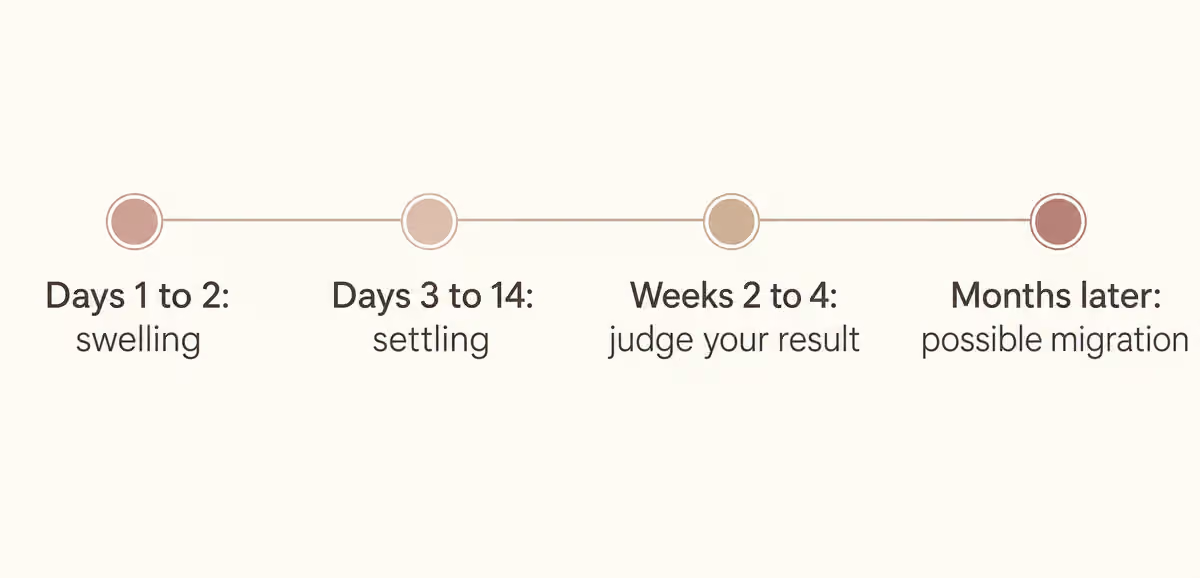
Swelling. In the first 48 hours your lips are inflamed. They are firm, they may be uneven, and the border can look indistinct simply because everything around it is puffy. This is not migration. It is the expected response to being injected, and it is covered in our filler aftercare guide.
Product still settling. Between roughly day 3 and week 2, swelling resolves and the filler integrates with the tissue. Lips commonly look their best around week 2 to 4, not on day one. Judging your result before week 2 is the single most common reason people panic unnecessarily.
Actual migration. This develops slowly. It is typically noticed months after a treatment, often after several treatments, and it does not resolve on its own. If your border was crisp at week four and blurred at month seven, that is a different story from lips that looked odd the morning after.
The simplest test: compare against a photograph of yourself at four weeks post-treatment, not against your pre-treatment photo and not against how you looked yesterday. If the area above your border has changed since that four-week mark, the conversation is worth having. If you have no such photo, that is worth fixing at your next appointment, because standardised photography is what makes this question answerable rather than a matter of opinion.
Why It Happens
Several factors contribute, and they are not equally important.
Stacking is the big one. Booking a top-up before the previous product has gone is the most common route to migration, and it is very easy to do accidentally, because the standard advice is to return every six to twelve months.
That advice rests on an assumption that imaging has undermined. A 2024 review of magnetic resonance imaging in Plastic and Reconstructive Surgery – Global Open examined 33 patients treated in the mid-face and found hyaluronic acid still detectable years after treatment, with longevity reaching up to 15 years across various products (Master et al., 2024). A 2026 case report in the Journal of Cosmetic Dermatology describing two decades of repeated treatment reached a similar conclusion and noted that complete disappearance within the traditionally quoted timelines is not universal (Prager and Lusher, 2026).
Sit with what that means practically. If you have had lip filler every nine months for four years, you are not carrying one syringe of product. You may be carrying a meaningful fraction of all of it. Tissue has finite capacity, and when you exceed it, the excess has to go somewhere. Usually that is outward and upward, across the border.
This is also why "it will just dissolve on its own eventually" is poor advice. Sometimes it will. Sometimes it is still visible on imaging a decade later.
Volume in a single session. Too much product placed at once in a lip that cannot accommodate it will spread, regardless of technique.
Placement depth and technique. Filler placed too superficially, or pushed too close to the border, has less to hold it in place. Product choice matters here too: a softer, less cohesive gel behaves differently in a mobile lip than a firmer one.
Anatomy and movement. Lips are among the most mobile tissue on the face. They are in constant use, and that movement, over months, works on whatever has been placed there. Some people's anatomy is simply more forgiving than others'.
How Common Is It, Honestly
Nobody knows, and you should be suspicious of any page that gives you a percentage.
There is no reliable prevalence figure for filler migration. It is under-reported because it is usually a cosmetic concern rather than a medical one, patients often go elsewhere for correction rather than back to the original injector, and there is no registry capturing it. Published work tends to be case reports and imaging studies rather than population data.
What can be said fairly: it is common enough that every experienced injector has seen it and has corrected it, and it is far more associated with cumulative treatment history than with a single unlucky appointment.
What Does Not Fix It
Adding more filler. This is intuitive, because the lip looks like it has lost definition and filler restores definition. It is also the fastest way to make the problem permanent-feeling. You are adding volume to tissue that has already demonstrated it cannot hold what is there.
Massage. Once product has settled outside the intended plane, pressing on it does not return it. Aggressive massage of an established migration risks spreading it further.
Waiting. Sometimes reasonable, given that some product does break down. But the imaging evidence above means waiting can mean waiting years, and in the meantime any further treatment compounds it.
What Does Fix It
The established approach is to dissolve the migrated product, allow the tissue to recover, and then rebuild conservatively if you still want volume.
Dissolving uses an enzyme that breaks down hyaluronic acid. It is a prescription medication, administered by a clinician after assessment. It is not something to source independently or have done outside a clinical setting, and the market in unregulated dissolving is genuinely dangerous.
Be clear-eyed about what it involves, because most articles present it as a clean undo button and it is not.
- It is not selective. The enzyme breaks down hyaluronic acid, and the review literature notes it can act on other glycosaminoglycans in the area as well. It does not distinguish your filler from your own tissue's hyaluronic acid. That native HA does replenish, but the area can look deflated and older than you expect in the interim, sometimes markedly so.
- It may take more than one session. Filler that has been in place a long time can become encapsulated, which reduces how accessible it is to the enzyme (Prager and Lusher, 2026). Long-standing, heavily layered product is the hardest to remove.
- You will not go straight back to filler. Expect a wait of several weeks for tissue to settle before anyone assesses you for retreatment. Rushing this reproduces the original problem.
- The result is not always a return to baseline. Tissue that has been stretched by years of product may not fully recoil. This is worth knowing before you start, not after.
None of this is an argument against dissolving. It is usually the right call. It is an argument for hearing the whole picture first.
One Important Exception: Not All Filler Can Be Dissolved
The enzyme only works on hyaluronic acid.
Other injectables work differently. Sculptra is poly-L-lactic acid, which stimulates your own collagen rather than adding a gel, and there is no enzyme that reverses it. It is not used in lips, and it is not associated with the migration pattern described here, but the general principle matters: before any injectable, know which product is going in and whether it is reversible.
If you do not know what was used on you previously, say so at your consultation. It changes what can be offered.
When It Is Not Migration and Needs Urgent Attention
Migration is a cosmetic problem that develops over months. It does not hurt.
Filler that causes sudden severe pain, skin that turns white or dusky and mottled, or any change in vision is a different situation entirely and needs immediate assessment, not a booked appointment. That is vascular compromise, and it is time-critical. We publish a real case study of a suspected vascular occlusion so people can see what it actually looks like and how it is managed.
These two things are not on a spectrum. If you are in pain, do not wait to see whether it settles.
How to Avoid It in the First Place
- Space your treatments properly. Longer than you have probably been told. Let product genuinely go before adding more, and accept that your interval may need to lengthen over the years rather than stay fixed.
- Go conservatively, especially early. Half a syringe that looks good beats a full syringe you regret. At Arlo, lip treatment starts at $325 for a half syringe and $650 for a full syringe, and a half is frequently the right answer for a first treatment.
- Insist on standardised photography. Without it, "has this changed?" is unanswerable.
- Ask what is being used and where it is going. A good injector will tell you the product, the plane, and why.
- Be honest about your history. Every previous treatment, as far back as you can remember, including anything done elsewhere. This is the information that most changes the plan, and it is the information people most often round down.
- Choose someone who will decline. The most protective thing an injector can do is tell you that today is not the day. If nobody has ever said no to you, that is worth noticing.
The Short Version
Do not judge your lips before week four. Real migration develops over months, not days. It is usually the result of accumulated product rather than one bad appointment, and the imaging evidence suggests that accumulation is larger than the industry's standard timelines imply. Adding more filler does not fix it. Dissolving usually does, but it is a real intervention with real trade-offs, not an undo button.
If you are unsure which of these you are looking at, that is exactly what an assessment is for. Book a complimentary consultation and we will tell you honestly, including if the answer is that nothing needs doing.
Frequently Asked Questions
How do I know if my filler has migrated or if it is just swelling?
Timing is the clearest signal. Swelling appears immediately and resolves within days. Filler continues settling for up to two to four weeks. Genuine migration develops over months and does not resolve on its own. Comparing a current photo against one taken four weeks after your last treatment is the most reliable check.
How long does it take for filler to migrate?
There is no fixed timeline, but it is generally a matter of months to years rather than days, and it is more commonly noticed after several rounds of treatment than after a first one.
Will migrated filler go away on its own?
Sometimes, but the evidence suggests this can take far longer than the commonly quoted 6 to 12 months. MRI studies have found hyaluronic acid still detectable years after treatment. Waiting is a reasonable choice, but not on the assumption it will clear within a year.
Does dissolving filler ruin your lips?
No, but it is a real intervention. The enzyme is not selective and can affect your own tissue's hyaluronic acid as well as the filler, so the area often looks deflated for a period before it recovers. Tissue that has held product for many years may not fully return to its original state. This is worth discussing in detail before you proceed.
Can I get filler again after dissolving?
Usually yes, after allowing several weeks for the tissue to settle and be reassessed. Going straight back to filler is how the original problem repeats.
Is filler migration dangerous?
Migration itself is a cosmetic concern rather than a medical emergency. Sudden severe pain, skin colour changes, or any visual change after filler are different and need immediate attention.
Can Sculptra migrate, and can it be dissolved?
Sculptra is poly-L-lactic acid, not hyaluronic acid, so the dissolving enzyme does not work on it. It is not used in lips and does not produce the border-blurring pattern described here. The wider point stands: always know which product you are receiving and whether it is reversible.
Related Reading
- Dermal Fillers at Arlo Medical
- Dermal Filler Aftercare
- How Long Do Dermal Fillers Last?
- Lip Filler in Calgary
- Vascular Occlusion From Lip Filler: A Real Case Study
References:
- Master M, Azizeddin A, Master V. Hyaluronic Acid Filler Longevity in the Mid-face: A Review of 33 Magnetic Resonance Imaging Studies. Plastic and Reconstructive Surgery – Global Open. 2024;12(7):e5934.
- Prager M, Lusher J. Long-term Persistence of Hyaluronic Acid Fillers: A Clinical Illustration and Implications for Practice. Journal of Cosmetic Dermatology. 2026.
Last Updated:
September 10, 2026

Ready to Discuss Your Botox Treatment?
Book a consultation at our Calgary location to get a personalized treatment plan. Every face is different and yours deserves an approach that's tailored specifically to you.