How to Choose a Medical Spa in Calgary: 9 Questions to Ask First
The clinic you choose matters more than the product they inject. Here is what to ask before you book.
August 6, 2026

Quick answer: Choose a medical spa based on who is actually holding the needle, not the price on the promotion. Ask about the injector’s credentials and how long they have been injecting, whether products are Health Canada authorized and shown to you sealed, whether you get a real consultation before treatment, and what the plan is if something goes wrong. A clinic that answers all four openly is a clinic worth booking.
Searching for a medical spa in Calgary turns up dozens of options, and from the outside they can look interchangeable. Similar treatment menus, similar before-and-after galleries, similar promotions.
They are not interchangeable. The single biggest variable in your result is not which product goes in the syringe. It is the judgment and experience of the person injecting it, and the standards of the clinic behind them.
Here are the nine questions worth asking before you book anything.
1. Who will actually be treating me?
This sounds obvious, and it is the question people most often forget to ask.
Find out the specific credential of the person performing your treatment. In Alberta, injectables are administered by regulated health professionals, which includes registered nurses, nurse practitioners, and physicians. At Arlo Medical, treatments are performed by registered nurse injectors.
What you want to avoid is ambiguity. If a clinic is vague about who does the injecting, or if the person who consults with you is not the person who treats you, ask why.
2. How long have you been injecting, and how often?
Credentials get someone in the door. Volume and time build judgment.
Injecting well is a skill that improves with repetition, because faces are not uniform. Anatomy varies, and knowing where blood vessels sit in your face is what separates a good result from a complication. Ask how long your injector has been practising and roughly how many treatments they perform in a typical week.
3. What products do you use, and can I see them?
Ask which brand of filler or neuromodulator will be used, and whether it is Health Canada authorized.
Then ask something more specific: will the product be opened in front of you? Reputable clinics draw from sealed, single-use, properly labelled product and have no problem showing you. Unauthorized or improperly stored product is a genuine risk in this industry, and it is a question you are entitled to ask.

4. Will I get a real consultation first?
A consultation should happen before any treatment, and it should involve more than confirming what you already decided to buy.
A proper consultation covers your medical history, medications, previous treatments, what you actually want to change, and whether the treatment you came in asking for is the right one. Sometimes it is not.
That last part is the tell. A clinic willing to talk you out of something, or to suggest a different approach than the one you walked in requesting, is a clinic prioritising your result over the sale.
5. What happens if something goes wrong?
Every clinic has good outcomes to show you. Fewer will talk openly about complications.
Ask directly: what is your protocol if there is a complication? For dermal fillers specifically, ask whether they keep hyaluronidase on site, the enzyme used to dissolve hyaluronic acid filler in an urgent situation such as a suspected vascular occlusion. Ask who you call after hours.
We wrote up a real vascular occlusion case from our own clinic because we think patients deserve to see how these situations are actually managed rather than pretending they never happen. A clinic that can discuss complications calmly and specifically has thought about them in advance.
6. Is the pricing transparent, and what am I paying per unit or syringe?
Pricing in aesthetics is genuinely confusing, and vagueness is often deliberate.
Ask what the cost is per unit or per syringe, how many you are likely to need, and what the total will be. Ask whether the consultation is charged and whether follow-up or touch-ups are included.
Be cautious with deep discounts on injectables. Product and practitioner time have real fixed costs, so an unusually low price is coming from somewhere: less experienced injectors, over-diluted product, or product from an unauthorized source.
7. Do the before-and-after photos look like real patients?
Look for unretouched photos in consistent lighting, at consistent angles, on faces that resemble yours in age and concern.
Be sceptical of galleries where the lighting or makeup changes dramatically between images. And remember that individual results vary genuinely, not just as a disclaimer.
8. Do they treat the concern, or just sell the treatment?
There is a meaningful difference between a clinic organised around products and one organised around concerns.
If you come in bothered by tired-looking eyes, the right first conversation is about what is actually causing that appearance: lost volume, skin laxity, texture, or the eyelid itself. Those lead to genuinely different treatments. A clinic that starts with your concern rather than this month’s promotion is more likely to get you somewhere.
9. Do you feel comfortable there?
Less measurable, still important. You should feel able to ask basic questions without feeling rushed or judged, and able to say no.
If you feel pressured into a decision or upsold during a consultation, that instinct is data. Aesthetic treatments are elective. There is no situation where you need to decide today.
Medical spa versus day spa: the practical difference
The terms get used loosely, so it is worth being clear.
A day spa offers relaxation and cosmetic services such as facials and massage, delivered by aestheticians. No regulated medical treatments.
A medical spa offers treatments that require a regulated health professional: injectables, prescription-strength devices, medical-grade resurfacing. That is the category Arlo Medical sits in, and it is why the credential questions above matter so much more than they would at a day spa.
Some clinics blur the line by offering both. That is not inherently a problem, as long as the medical treatments are being performed by appropriately regulated practitioners.
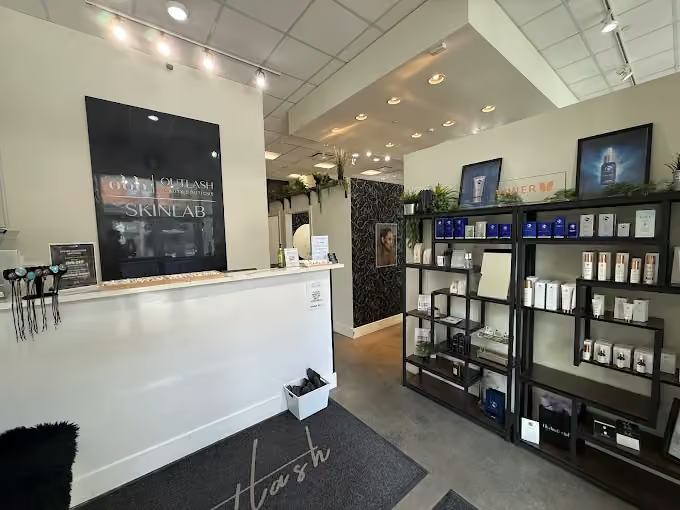
What this looks like at Arlo Medical
We are a small clinic in Calgary’s Beltline, and treatments are performed by registered nurse injectors. Our consultations are genuinely consultative: if what you are asking for is not the best route to what you actually want, we will tell you and explain why.
You can read about our team and approach, browse our treatments, or look at how we handle specific concerns across injectables and Dysport and Botox. If you are still deciding between neuromodulators, our comparison of Botox and Dysport walks through the practical differences.
Wherever you end up booking, ask the nine questions. A clinic that answers all of them openly has earned the appointment.
Ready to talk to someone? Book a consultation and we will walk through your goals, what is realistic, and what we would actually recommend. No pressure to book treatment on the day.
Frequently asked questions
Do I need a doctor to perform injectables in Alberta?
No. In Alberta, injectables may be administered by several categories of regulated health professional, including registered nurses and nurse practitioners. What matters is that your injector holds a current registration with their regulatory college and has substantial hands-on injecting experience. At Arlo Medical, treatments are performed by registered nurse injectors.
What is the difference between a medical spa and a day spa?
A day spa provides cosmetic and relaxation services such as facials and massage, delivered by aestheticians. A medical spa provides treatments that require a regulated health professional, including injectables and medical-grade devices. The credentials of the person treating you are the practical difference.
Should I be worried about very cheap injectable pricing?
It is worth asking questions. Product and practitioner time carry real fixed costs, so unusually low pricing generally reflects a trade-off somewhere, whether that is injector experience, product dilution, or product sourced outside authorized channels. Ask what product is being used, whether it is Health Canada authorized, and whether it will be opened in front of you.
What should happen at a first consultation?
A review of your medical history and medications, a discussion of what you want to change, an honest assessment of whether the treatment you are considering will achieve that, a clear explanation of cost, and time to ask questions. You should never feel obliged to proceed with treatment on the same visit.
How do I know if a clinic is prepared for complications?
Ask directly. For hyaluronic acid dermal fillers, ask whether hyaluronidase is kept on site to dissolve filler in an urgent situation, and ask who you contact after hours. A clinic that can answer specifically and without discomfort has planned for it.
Last Updated:
August 6, 2026



Ready to Discuss Your Botox Treatment?
Book a consultation at our Calgary location to get a personalized treatment plan. Every face is different and yours deserves an approach that's tailored specifically to you.