Botox vs Dysport: What's the Difference and Which Is Right for You?
Compare speed, spread, cost & results. Get expert help choosing the right injectable treatment for smooth, natural-looking skin.
May 20, 2026
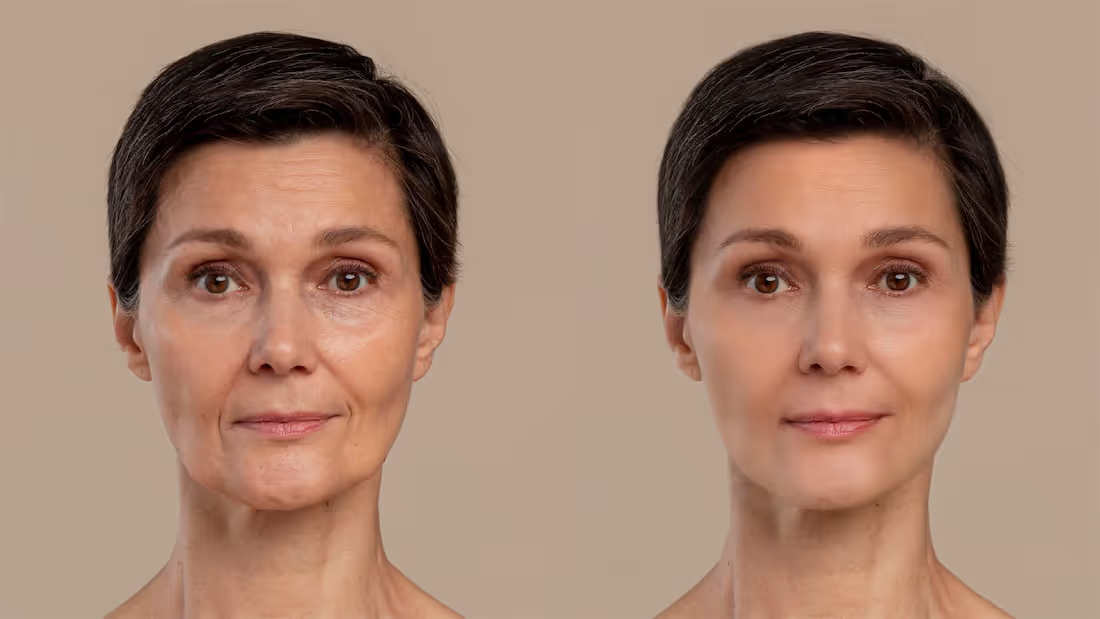
Quick answer: Botox and Dysport are both botulinum toxin neuromodulators. Dysport spreads slightly more (well-suited for larger areas like the forehead), while Botox is more precise (better for smaller zones). Onset and longevity are similar (3–4 months) and overall treatment costs are typically comparable.
If you're considering injectable treatments to smooth forehead lines, frown lines, or crow's feet, you've likely come across both Botox and Dysport. While these wrinkle-relaxing treatments work in remarkably similar ways, subtle differences in how they're formulated, how quickly they work, and how they spread can significantly impact your results.
The good news? Both are FDA-approved, clinically proven, and safe when administered by experienced medical professionals. The better news? Understanding the key differences means you can make a confident, informed decision about which treatment aligns best with your goals, timeline, and facial anatomy.
Let's break down everything you need to know.
Quick Comparison: Botox vs Dysport at a Glance
| Feature | Botox | Dysport |
|---|---|---|
| Active Ingredient | OnabotulinumtoxinA | AbobotulinumtoxinA |
| FDA Approval (Cosmetic) | 2002 | 2009 |
| Results Appear | 5-7 days (full results: 10-14 days) |
2-3 days (full results: 7-10 days) |
| How Long It Lasts | 3-4 months (sometimes up to 6) |
3-4 months (sometimes up to 5-6) |
| Diffusion (Spread) | More localized, precise | Spreads more easily over larger areas |
| FDA-Approved Areas | Forehead lines, frown lines, crow's feet | Frown lines (glabellar) only |
| Unit Conversion | 1 unit | ≈ 2.5-3 units |
| Best For | Targeted areas, crow's feet, precise control | Broader areas like full forehead |
| Cost Per Unit | $10.50/unit | $9.50/unit |
| Typical Treatment Cost | $210-420 (based on 20-40 units) |
$285-475 (based on 30-50 units) |
Note: Units are not interchangeable between products. Your provider will determine the appropriate dosage for your treatment area and goals.
What Are Botox and Dysport?
Both Botox and Dysport are neuromodulators — injectable treatments that temporarily relax the facial muscles responsible for creating dynamic wrinkles (the lines that appear when you smile, frown, or squint).
How They Work
When you make repeated facial expressions over the years, the underlying muscles contract, causing the skin to crease. Over time, these creases become visible even when your face is at rest — that's when fine lines become permanent wrinkles.
Botox and Dysport work by blocking nerve signals to these muscles. Without the signal to contract, the muscles relax, allowing the overlying skin to smooth out. The result? Softer, less noticeable lines while maintaining natural facial movement and expression.

What Makes Them Different?
While both contain botulinum toxin type A, they use different formulations based on the proteins attached to the active molecule:
- Botox contains a more complex protein structure that keeps the product more localized after injection
- Dysport has a smaller molecular structure with different proteins, allowing it to diffuse more easily
Think of it like this: Botox is like a precise brush stroke, while Dysport is more like a soft watercolor wash. Neither is better — they're simply designed for different effects.
The Key Differences That Actually Matter
1. Speed: How Quickly You'll See Results
- Dysport: 2-3 days (full results: 7-10 days)
- Botox: 5-7 days (full results: 10-14 days)
Why it matters: If you're treating yourself before a wedding, vacation, or special event, Dysport's faster onset can be a significant advantage. Many patients notice visible improvements within 2-3 days with Dysport, compared to nearly a week with Botox.
That said, both treatments reach their peak effect around the two-week mark, so for general maintenance, the speed difference is less critical.

2. Diffusion: How the Product Spreads Under Your Skin
- Dysport spreads more → Better for larger areas like the forehead
- Botox stays more localized → Better for precision in smaller, targeted areas
Why it matters: Dysport's ability to diffuse makes it particularly effective for treating broad treatment zones with fewer injection points. For example:
- Forehead lines across a wider area? Dysport may give you smoother, more even coverage
- Crow's feet or precise lip lines? Botox's controlled placement can deliver more targeted results
An experienced injector understands these diffusion properties and will adjust injection techniques accordingly — placing Dysport slightly differently than Botox to optimize results and prevent unwanted spread into adjacent muscles.
3. Unit Dosing: Why "Units" Aren't the Same
This is where things get confusing: 1 unit of Botox ≈ 2.5-3 units of Dysport.
Dysport is more diluted than Botox, which means you need roughly three times as many "units" to achieve comparable results. Here's what this means in practice:
- Dysport costs slightly less per unit ($9.50 vs $10.50 for Botox)
- But you need 2.5-3x more units, so total treatment cost with Dysport can actually be higher
- Your provider measures dosage based on your specific treatment area and goals, not arbitrary unit counts
Never compare unit counts between the two products — they're measured on completely different scales.
Example: Treating Frown Lines (Glabellar Lines)
- Botox: 20 units = $210
- Dysport: 50 units = $475
Same treatment area, comparable results, but Dysport requires more units due to different dilution.
4. FDA Approvals: Where Each Product Can Be Used
Botox has broader FDA approval for cosmetic use:
- Forehead lines (horizontal)
- Frown lines between eyebrows (glabellar/11 lines)
- Crow's feet (lines around eyes)
Dysport is FDA-approved for:
- Frown lines between eyebrows (glabellar/11 lines) only
What this means for you: Both products are commonly used "off-label" by experienced providers to treat other areas with excellent safety records. However, Botox's wider FDA approval gives some patients additional confidence when treating areas like crow's feet or forehead lines.
5. Duration: How Long Results Last
Both treatments typically last 3-4 months, though individual results vary based on:
- Metabolism — faster metabolisms may process the product more quickly
- Muscle strength — stronger, more active muscles may require more frequent touch-ups
- Treatment area — some areas (like crow's feet) may last longer than others (like forehead)
- Dosage — proper dosing is crucial for longevity
Some patients report that results can last up to 5-6 months, particularly after multiple treatment cycles when muscles are trained to relax more easily.
With regular treatments over time, many patients find they can extend the time between appointments as their muscles adapt.
Which Treatment Is Right for You?
There's no universally "better" option — the right choice depends on your unique facial anatomy, treatment goals, and personal preferences.
Choose Dysport If:
✓ You want faster visible results (special event coming up)
✓ You're treating larger areas like the full forehead
✓ You prefer a softer, more diffused effect
✓ You've experienced a "heavy brow" feeling with Botox
✓ You want slightly more retained movement in treated areas
Choose Botox If:
✓ You need precise, targeted treatment in smaller areas
✓ You're treating crow's feet or other delicate zones
✓ You prefer the product with broader FDA approval
✓ You want the most studied, longest-established option
✓ Your provider has more experience with Botox
Consider Trying Both If:
✓ One hasn't given you the results you wanted
✓ Your provider recommends using both in different facial areas during the same session (Dysport for forehead, Botox for crow's feet, for example)
✓ You're curious to compare how each works with your body chemistry
Important: It's completely safe to switch between products. There's no waiting period required, though it's best to wait until your previous treatment has worn off so you can accurately assess the new product's effectiveness.

What to Expect: The Treatment Experience
Good news: the actual treatment process is nearly identical for both products.
Before Your Appointment
1-2 weeks before:
- Avoid blood thinners if possible (aspirin, ibuprofen, fish oil, vitamin E)
- Stop alcohol consumption 24-48 hours prior
- Avoid supplements like ginkgo biloba, garlic, and ginseng
- Let your provider know about any medications you're taking
Day of treatment:
- Arrive with a clean face (no makeup in treatment areas)
- Bring a list of any current medications
- Prepare your questions for your provider
During Treatment
Both Botox and Dysport injections take 10-15 minutes total:
- Your provider will assess your facial movements and mark injection points
- The treatment area may be cleaned with antiseptic
- A series of small injections are administered using an ultra-fine needle
- Most patients describe the sensation as a quick pinch or mosquito bite
- You're done! No anesthesia or recovery time needed
Pain level: Minimal. Most patients tolerate the treatment easily without numbing. If you're concerned about discomfort, your provider can apply topical numbing cream or ice beforehand.

After Treatment
Both products have no downtime — you can return to normal activities immediately with a few simple precautions:
For the first 4-6 hours:
- Stay upright (avoid lying down)
- Don't rub or massage the treated areas
- Avoid strenuous exercise
- Skip saunas, hot tubs, and excessive heat
For the first 24 hours:
- Continue avoiding vigorous exercise and heat exposure
- Sleep with your head slightly elevated if possible
- Avoid facials, chemical peels, or other facial treatments
Minor, temporary side effects may include:
- Slight redness at injection sites (fades within an hour)
- Small bumps where the product was injected (resolve quickly)
- Mild bruising (uncommon, resolves within a few days)
- Light headache (rare, easily managed with over-the-counter pain relief)
Patient Questions Answered
Can I switch from Botox to Dysport (or vice versa)?
Absolutely. Many patients try both to see which works better for their individual needs. There's no waiting period required between switching products, and it's completely safe to alternate between treatments.
Why do I need more units of Dysport than Botox?
The unit measurements are simply different scales. Think of it like measuring temperature in Celsius vs Fahrenheit — different numbers, same result. Dysport is more diluted, so more units are needed. While Dysport costs slightly less per unit, you'll need about 2.5-3x more units, which can make the total treatment cost comparable or sometimes higher than Botox.
Will I look 'frozen' or unnatural?
When administered by an experienced provider using appropriate dosing, both products should soften lines while maintaining natural facial movement and expression. The goal is to look refreshed and rested, not frozen. If you've seen results that look unnatural, it's usually due to inexperienced injection technique or overdosing, not the product itself.
How do I know which areas to treat?
Your provider will assess your facial movements during your consultation to identify which muscles are creating your lines. Common treatment areas include:
- Forehead lines (horizontal lines when you raise your eyebrows)
- Frown lines/11 lines (vertical lines between eyebrows when you furrow your brow)
- Crow's feet (lines radiating from the outer corners of your eyes when you smile or squint)
- Bunny lines (lines across the bridge of your nose when you wrinkle it)
- Lip flip (subtle lift at the upper lip border)
What if I don't like the results?
While results are temporary (wearing off after 3-4 months), there's no way to immediately reverse neuromodulator treatments. This is why choosing an experienced, qualified injector is crucial. That said, side effects are rare, and most patients are very satisfied with their results. If you're not happy, your provider can make adjustments at your next appointment.
When will I need my next treatment?
Most patients return for maintenance treatments every 3-4 months. Your provider will work with you to determine the optimal timing based on when you notice movement beginning to return.
Choosing the Right Provider in Calgary
The quality of your results depends as much on your injector's skill as it does on the product choice. When selecting a provider for Botox or Dysport treatments in Calgary:
Look for:
- Medical training and credentials (physicians, nurse practitioners, or RNs under physician supervision)
- Extensive experience specifically with facial injectables
- A thorough consultation process that includes facial assessment
- Transparent pricing and realistic expectation-setting
- A medical facility with proper safety protocols
Ask questions:
- "How many years have you been performing injectable treatments?"
- "Do you have before/after photos I can review?"
- "Which product do you recommend for my specific concerns, and why?"
- "What happens if I'm not satisfied with my results?"
Red flags:
- Providers who can't show you their medical credentials
- Unusually low pricing (may indicate diluted product or inexperienced injector)
- Pressure to treat areas you're not interested in
- No consultation or facial assessment before treatment
- Treatment in non-medical settings (spas, salons, home parties)
The Bottom Line: Both Are Excellent Options
Botox and Dysport are both proven, safe, and effective treatments for smoothing dynamic wrinkles and preventing new lines from forming. The "better" choice isn't about the product itself — it's about:
Your specific treatment goals → What areas do you want to address?
Your timeline → Do you need faster results, or is timing flexible?
Your facial anatomy → Do you have broader or more targeted treatment areas?
Your provider's expertise → Which product does your injector have more experience with?
The truth is, many patients find both products work beautifully — sometimes even preferring to use both in different areas during the same treatment session.
The most important factor in achieving natural-looking, long-lasting results isn't whether you choose Botox or Dysport — it's partnering with an experienced medical professional who takes the time to understand your goals, assess your facial movements, and create a personalized treatment plan.
Ready to Smooth Away Fine Lines and Wrinkles?
At Arlo Medical Injections, we offer both Botox and Dysport treatments administered by experienced medical professionals who specialize in facial aesthetics. During your consultation, we'll:
- Assess your facial movements and identify which muscles are creating your lines
- Discuss your goals, timeline, and concerns
- Recommend the best treatment option (Botox, Dysport, or a combination) for your unique needs
- Answer all your questions in a pressure-free environment
- Create a personalized treatment plan with transparent pricing
Pricing:
- Botox: $10.50 per unit
- Dysport: $9.50 per unit
- Lip Flip: $60
- Complimentary consultations available
New to injectable treatments? We specialize in first-time patients and pride ourselves on creating comfortable, educational experiences.
Related Reading
Continue Your Research:
- The Evolution of Botulinum Toxin
- What Does Botox Do?
- How Many Botox Units Do You Need?
- How Long Does Botox Last?
Related Concerns We Treat:
Medical Disclaimer: This article is for educational purposes only and is not a substitute for professional medical advice. Individual results may vary. Both Botox and Dysport should only be administered by qualified healthcare professionals. Always consult with a licensed provider to determine if injectable treatments are appropriate for you.
Last Updated:
May 20, 2026

Ready to Discuss Your Botox Treatment?
Book a consultation at our Calgary location to get a personalized treatment plan. Every face is different and yours deserves an approach that's tailored specifically to you.